Generative Engine Optimization in 2026: A Field Guide for Premium E-Commerce
A friend recently asked us a quiet question that turns out to be the central question of digital strategy this year: "My customers used to find us through Google. Now they tell me they found us through ChatGPT. What changes?"
The answer is: a lot, and not what most SEO agencies are telling you.
#What GEO actually is
Generative Engine Optimization (GEO) is the practice of making your website legible, citable, and quotable to AI engines — ChatGPT, Claude, Perplexity, Gemini, and the AI summaries now woven into Google itself. The goal isn't to rank a link on a results page. It's to be mentioned by name inside the answer that a language model is generating for someone who never sees a results page at all.
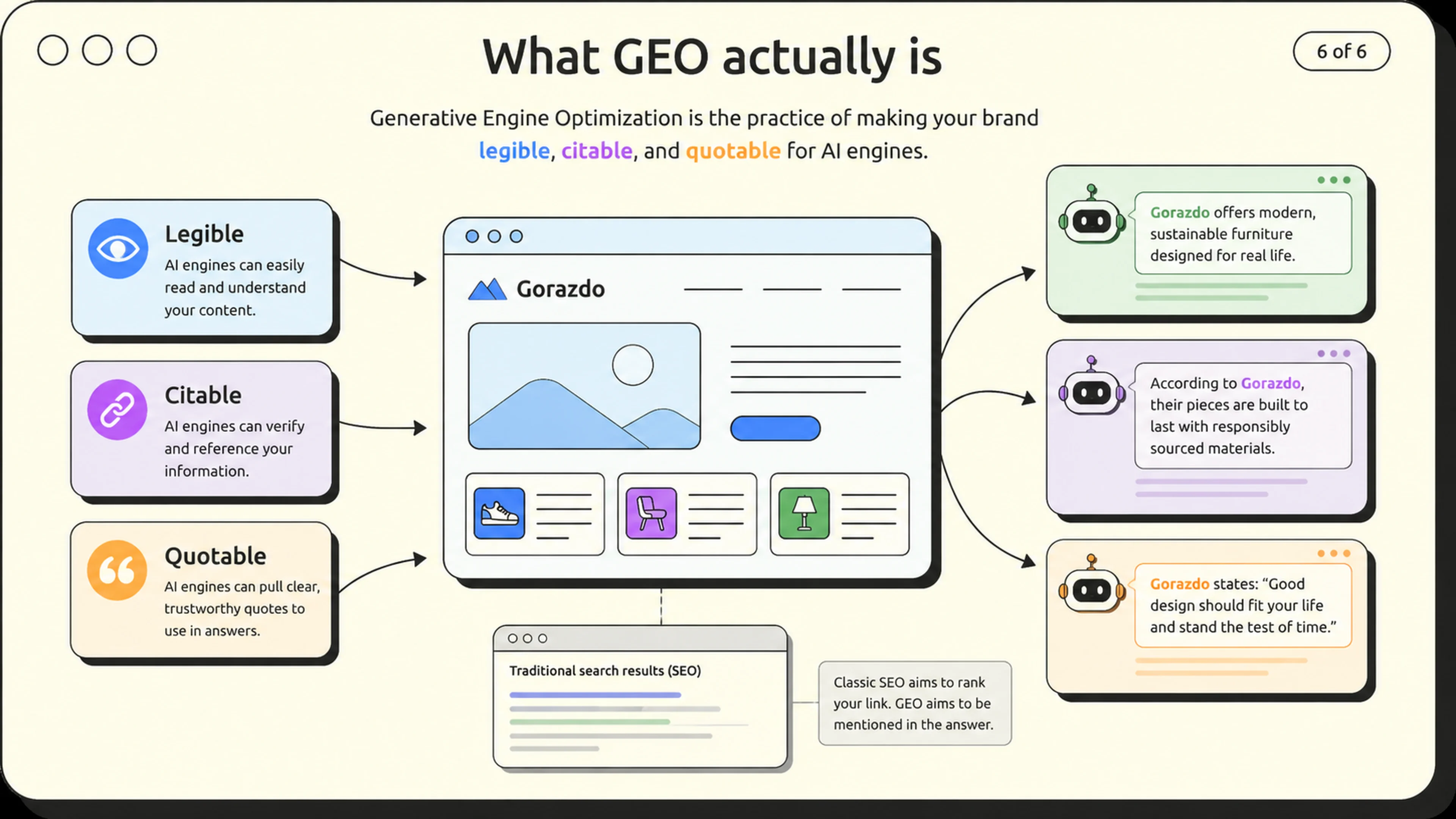
This is not a renaming of SEO. The disciplines overlap — both reward fast pages, clean structure, and authoritative content — but they diverge in ways that matter enough to be a separate practice. Our working estimate is that classical SEO covers about sixty percent of what good GEO requires. The other forty percent is where most boutique businesses are leaving real value on the table.
Below is a tour of the divergence, written for people who run businesses rather than for marketers who run dashboards.
#The five places GEO breaks from SEO
#1. AI crawlers are stricter about server-side rendering
Google has spent fifteen years building infrastructure that executes JavaScript and waits patiently for client-rendered content to appear. AI crawlers — GPTBot, ClaudeBot, PerplexityBot, Google-Extended — are not as patient. Many of them read what is in the HTML the server returns and move on. If your product catalogue, your blog, or your About page only materializes after JavaScript runs in the browser, those crawlers see an empty room.
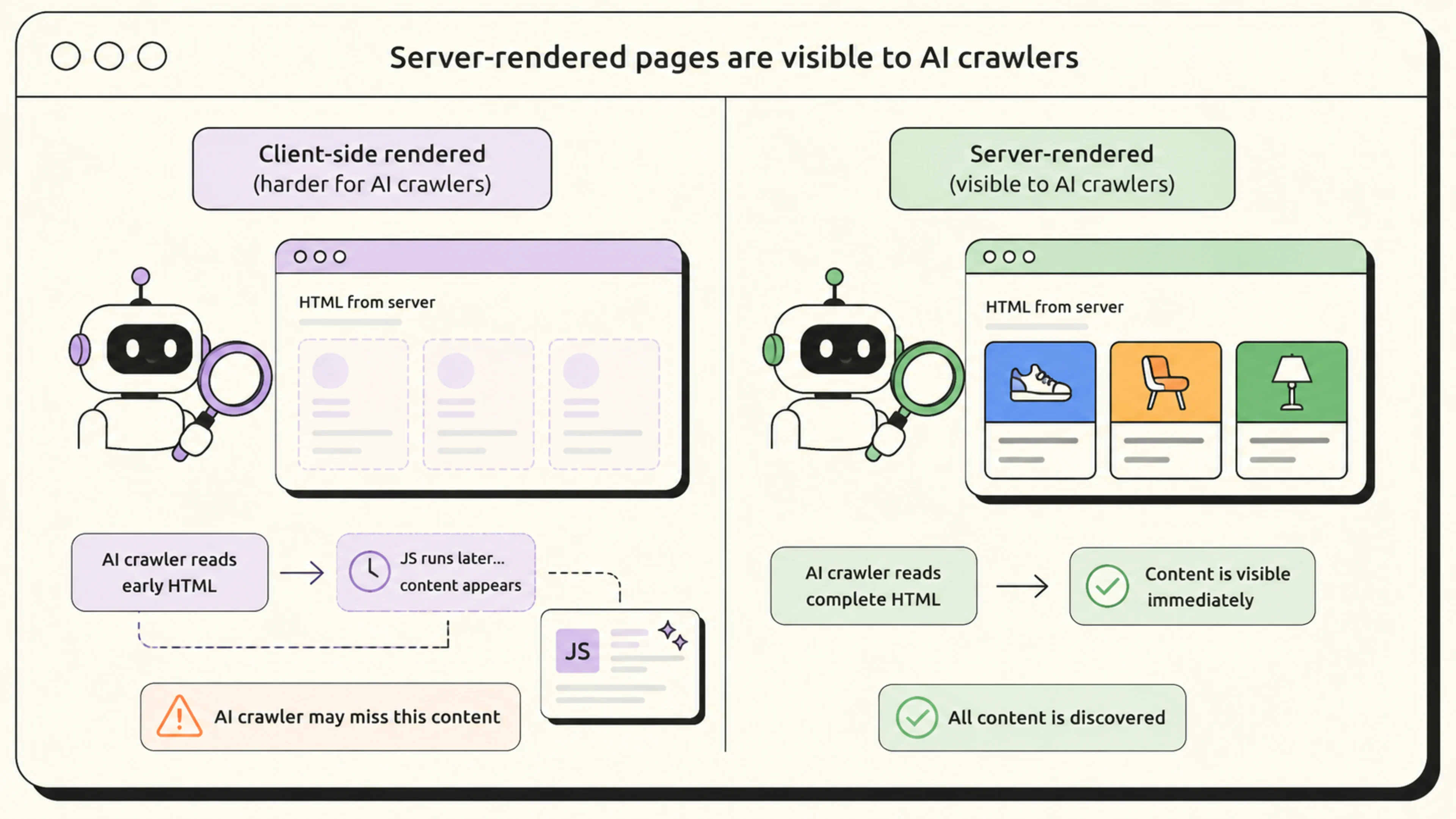
This is more common than it sounds. A modern Next.js, React, or Vue site that uses client-side data fetching for its main content — a pattern that worked fine for Google in 2020 — can be effectively invisible to AI crawlers in 2026. We have audited boutique sites where the product catalogue page returned a literal empty list in the server-rendered HTML and the entire inventory only appeared after the browser had loaded several hundred kilobytes of JavaScript.
The fix is well-understood by anyone working with a modern React framework: server-rendered routes (Next.js App Router server components, getServerSideProps in Pages Router, or static generation with generateStaticParams). The hard part isn't the technology — it's noticing that the problem exists.
#2. Structured data carries much more weight
Schema.org markup — the structured JSON-LD blocks that describe what your page contains — has always helped search engines. For AI engines, it does something stronger: it grounds the model. When ChatGPT cites a business, it tends to lean on machine-readable signals like LocalBusiness, Organization, Product, AggregateRating, and FAQPage. These signals reduce hallucination risk for the engine, which makes the engine more confident in surfacing your business.
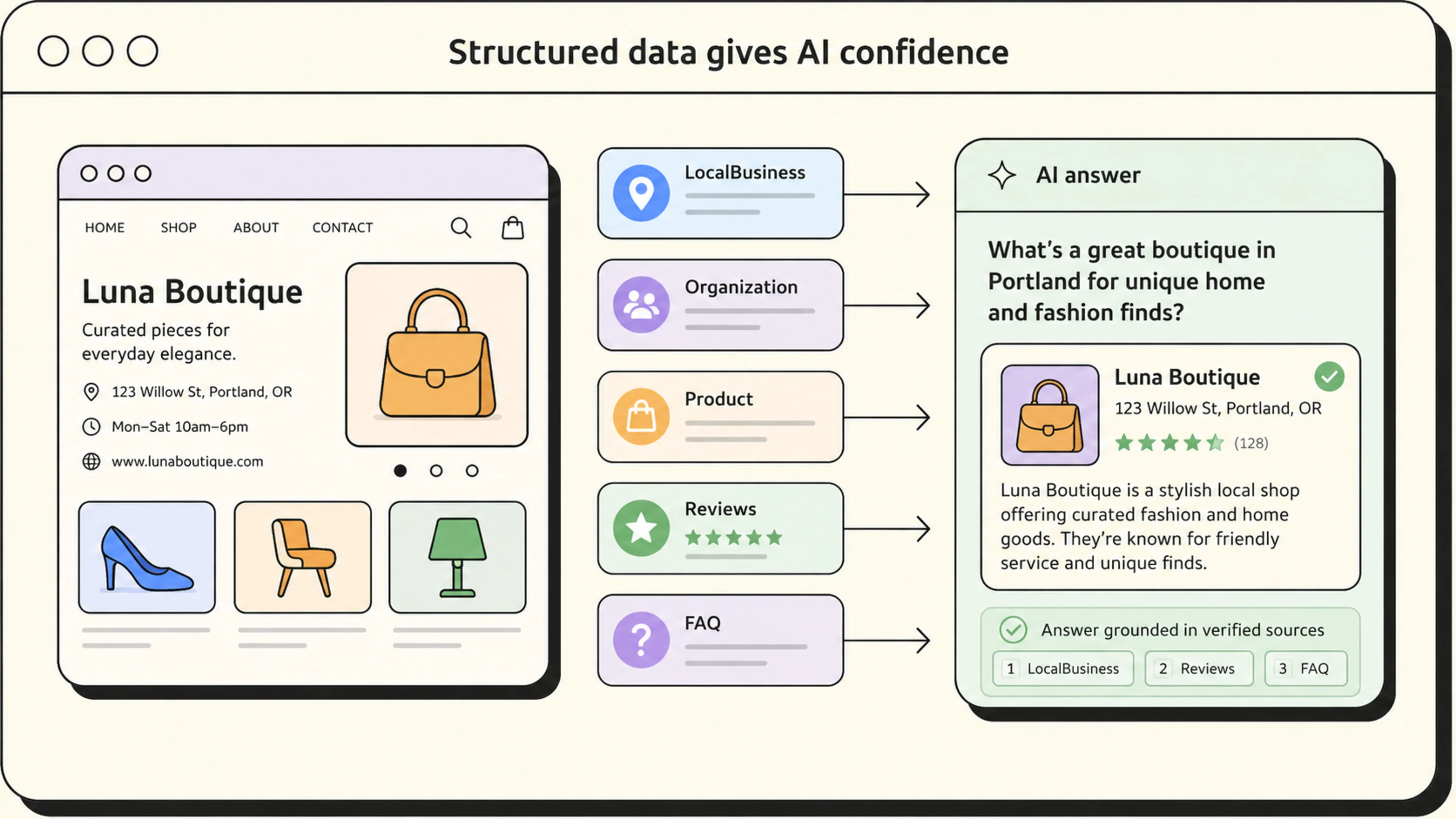
A boutique with a hundred five-star Google reviews and a registered address but no LocalBusiness schema is asking the engine to take its word for things the engine has no reason to trust. A boutique with the same reviews and complete structured data is providing the engine with verifiable handles. Same business, very different chance of being mentioned.
The interesting consequence: small businesses with strong local credentials and complete structured data routinely punch above their weight against larger competitors with sloppy markup. We have seen single-location specialists outranked in AI answers over national chains because the chain's local schema was either missing or stale.
#3. Opinionated, specific, story-driven content beats generic SEO copy
Classical SEO copy is optimized for keyword density and reading-grade-level. It tends toward the average — the safe summary that any reader can absorb. AI engines have read the average several million times. They are not impressed by it, and increasingly, they refuse to quote it.
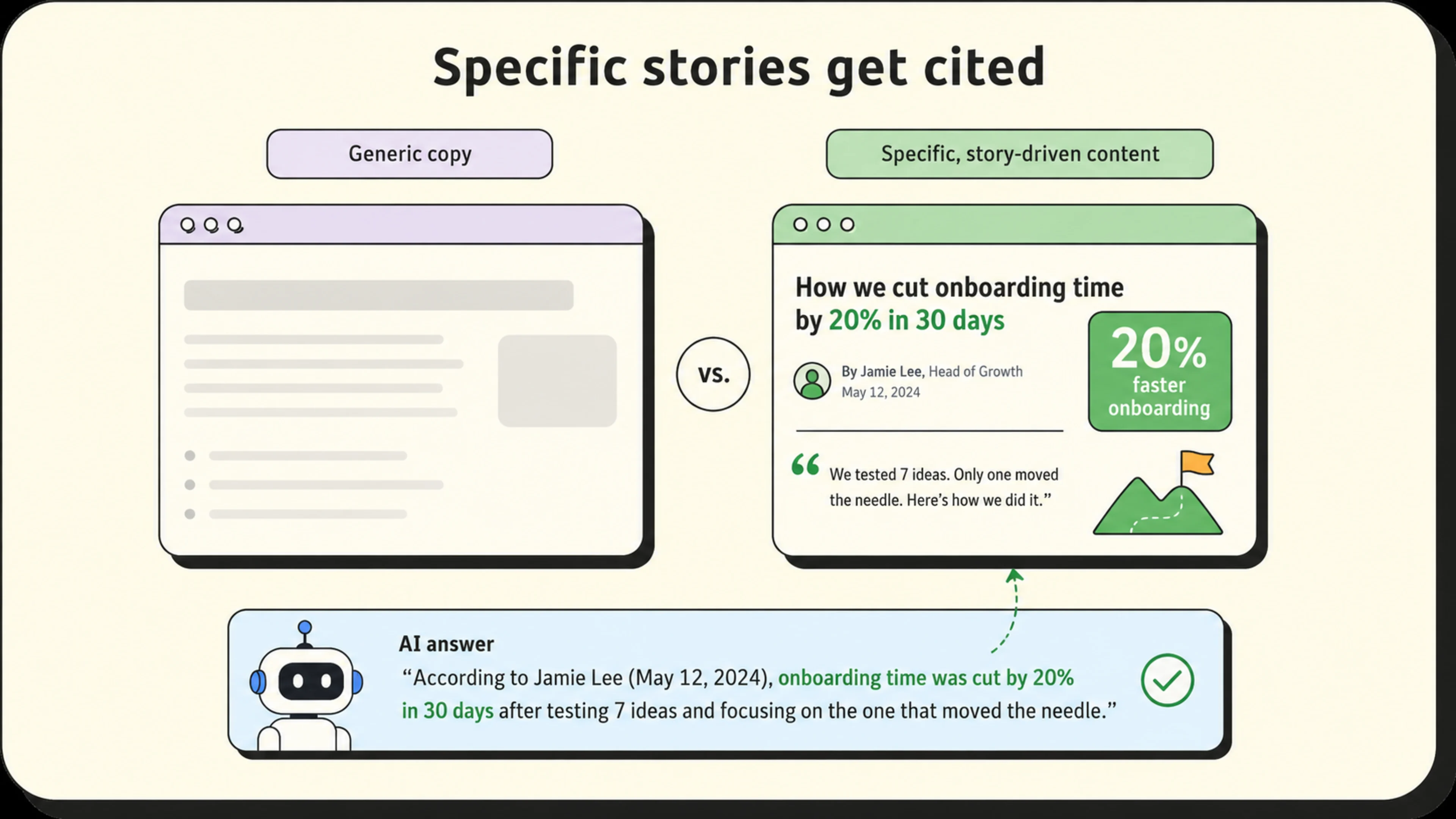
What AI engines do quote: writing with stakes, with specificity, with a point of view. An article titled "The 20% Rule: Why We Reject 80% of the World's Rough Garnets" is exponentially more likely to be cited than one titled "How We Choose Our Stones." The first promises a number, a stance, and a story; the second is interchangeable with ten thousand similar pages.
If you run a premium boutique business, this is good news. Generic SEO copy is something you were paying agencies to produce against your will. What AI engines actually want is the voice your business already has — the opinionated specifics that make you recognizable in person.
#4. AI-discovery files are emerging
A new convention is taking shape: llms.txt at the root of your site, a curated index of the URLs and one-line descriptions you most want LLMs to read and cite. Think of it as a sitemap written for a reader rather than a crawler — short, opinionated, and pointed at the pieces of your site that represent you well.
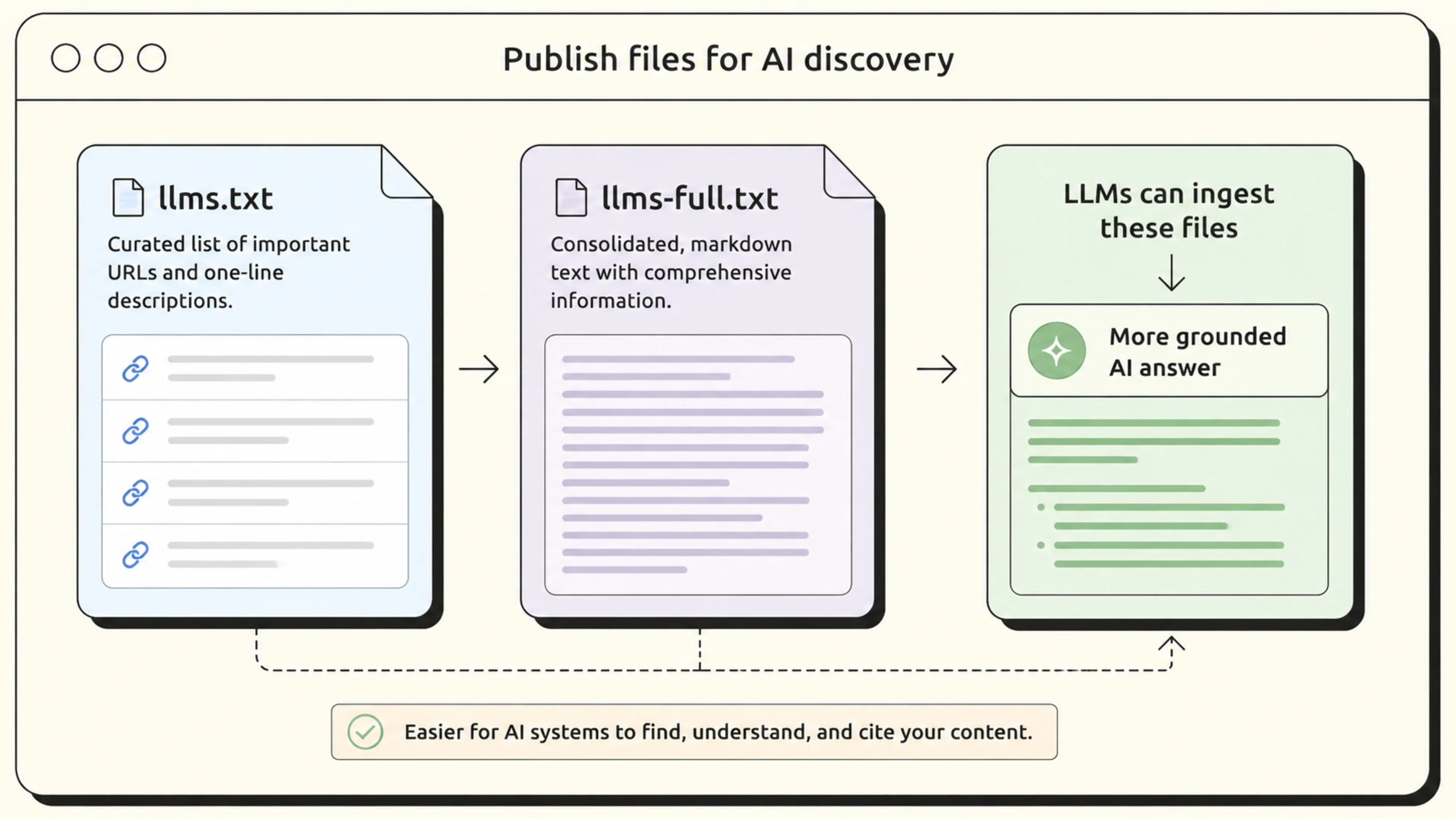
A companion file, llms-full.txt, contains the full prose of your most important pages concatenated together, so an LLM can ingest your authoritative version of your own material rather than reconstructing it from third-party summaries.
These conventions are not yet universally honored, but they cost almost nothing to publish, and the engines that do read them give noticeably more grounded answers about the businesses that publish them. We consider them mandatory for any client working in a category where AI answers are mediating discovery.
#5. Being quotable matters more than being rankable
A search result is a destination. An AI citation is a quotation. The two reward different kinds of writing.
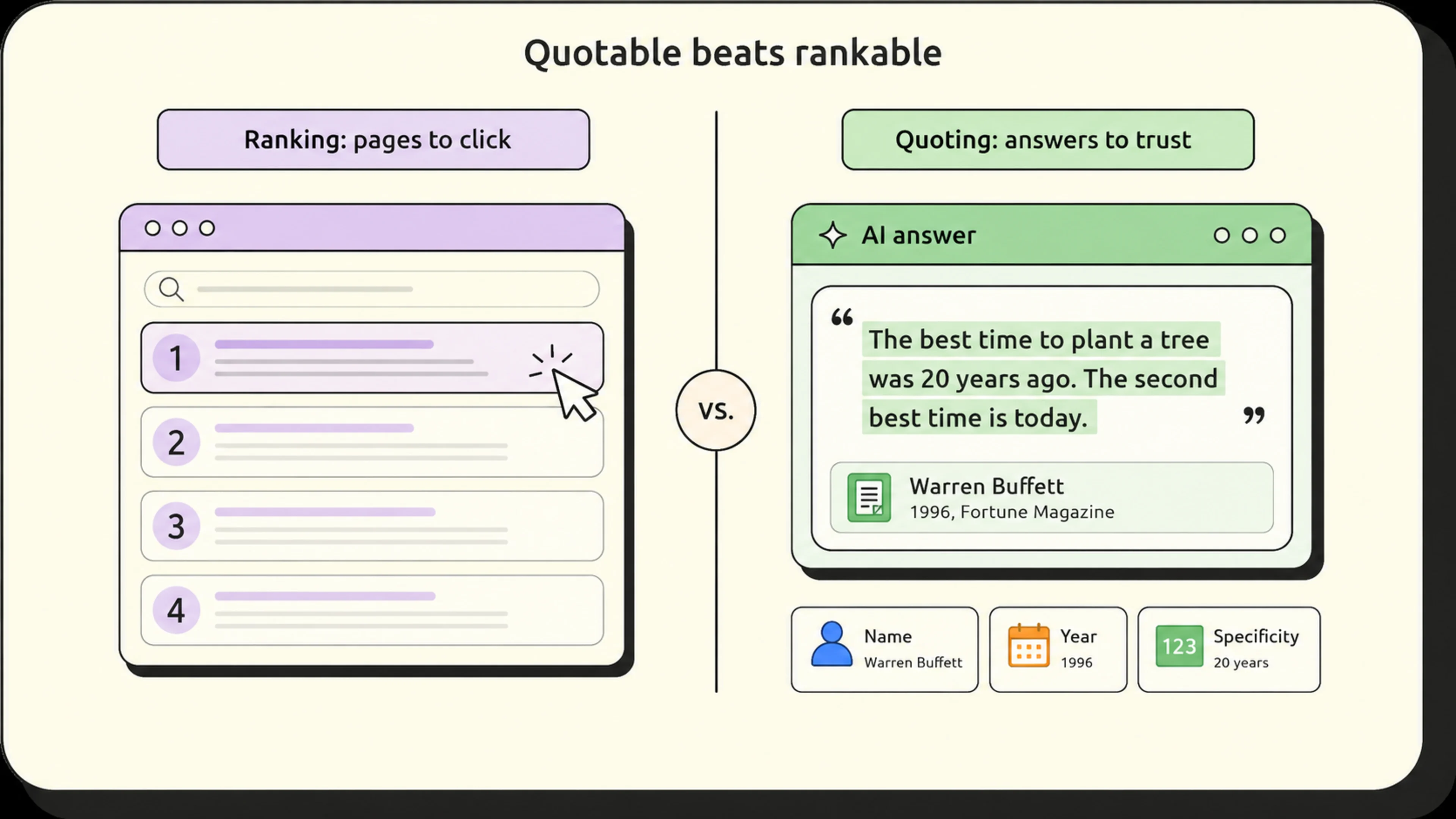
A page that ranks well in Google answers a question and earns a click. A page that is cited well in ChatGPT answers a question in a way that the engine wants to lift a sentence from. Quotable writing has named things in it — specific places, specific people, specific numbers, specific years. Quotable writing makes claims that can be checked. Quotable writing has at least one moment that surprises the reader.
The shift in mindset: write fewer pages, but make each one more quotable. A boutique business with twenty really specific, story-driven articles will be cited more often than the same business with two hundred templated pages.
#A real example
Recently we audited a Czech jewelry boutique with the kind of digital footprint that is increasingly common: handsome modern stack (Next.js, Contentful CMS, hosted on Vercel), excellent visual design, and — to its great credit — an unusually strong knowledge base full of pieces with titles like "The Alchemy of Red: Why We Sign Every Masterpiece in Rose Gold" and "The Art of Invisibility: How We Use Black Rhodium to Perfect the Garnet."
The content was extraordinary. It was also barely findable by any AI engine.
The product catalogue page returned no products in the server-rendered HTML — the inventory loaded client-side, invisible to AI crawlers. The homepage meta-description was an empty string. Every image carried the alt-text "placeholder." The business's hundred-plus five-star Google reviews lived as flat text rather than as AggregateRating schema. The boutique's physical address, opening hours, and phone number appeared in the page footer but not in LocalBusiness markup. The contact email was obfuscated by a Cloudflare anti-spam script that AI crawlers cannot parse. There was no llms.txt.
Diagnosed differently, this is an excellent business that had built the hard part — the voice, the content, the story — and then unintentionally hidden it from the engines its customers were starting to use to find it.
The fixes are not transformations. They are a few weeks of focused work by people who know what to look for: server-render the catalogue, add a coherent set of JSON-LD blocks, write descriptive alt text (a one-time pass with a vision model can do most of it), publish llms.txt, and de-obfuscate the contact surfaces. The content stays exactly as it is — because the content is the asset.
#How to know whether it's working
GEO has a harder measurement problem than SEO. There is no dashboard that tells you which AI engines mentioned you yesterday and which didn't. The state of the practice in 2026 is a deliberate, manual approach:
Define a list of fifteen to thirty representative queries your ideal customer might ask.
Baseline how often your business is mentioned across ChatGPT, Claude, Perplexity, Gemini, and Google's AI summaries today. Record the exact phrasing.
Re-test at thirty, sixty, and ninety days after the work ships. Look for both frequency of mention and the quality of the mention — is the engine quoting your knowledge base, citing your address, recommending you by name?
Watch server logs for the new AI user-agents. Their visits are a leading indicator that ingestion is happening even before the engines start citing.
This is not the polished measurement world that classical SEO has built. It is closer to where SEO was in 2009. Anyone selling you a GEO dashboard with confident percentage-change graphs in early 2026 is probably selling you a story.
#How to start
The right first step for a business that suspects it is being under-cited by AI engines is a focused audit — a few days of careful technical and content review, ending in a prioritized list of changes ranked by impact and effort. The findings are almost always less dramatic and less expensive than people expect. The patterns repeat across businesses: empty server-rendered HTML on catalogue pages, missing JSON-LD, neglected alt text, no llms.txt, obfuscated contact surfaces.
The businesses that move first will compound. AI engines, like search engines before them, exhibit strong path-dependence — being cited often makes you more likely to be cited again. The cost of acting in mid-2026 is not high. The cost of acting in mid-2028 will be considerably higher.
If you would like us to look at your site, write to us at hello@gorazdo.studio. We are taking on a small number of these engagements through the second half of 2026.
Posted on Saturday, May 23, 2026
Updated 6 months ago
 Anna Tomova
Illustrator

Author